![[personal profile]](https://www.dreamwidth.org/img/silk/identity/user.png) samhiggins posting in
samhiggins posting in ![[community profile]](https://www.dreamwidth.org/img/silk/identity/community.png) asianamlitfans
asianamlitfans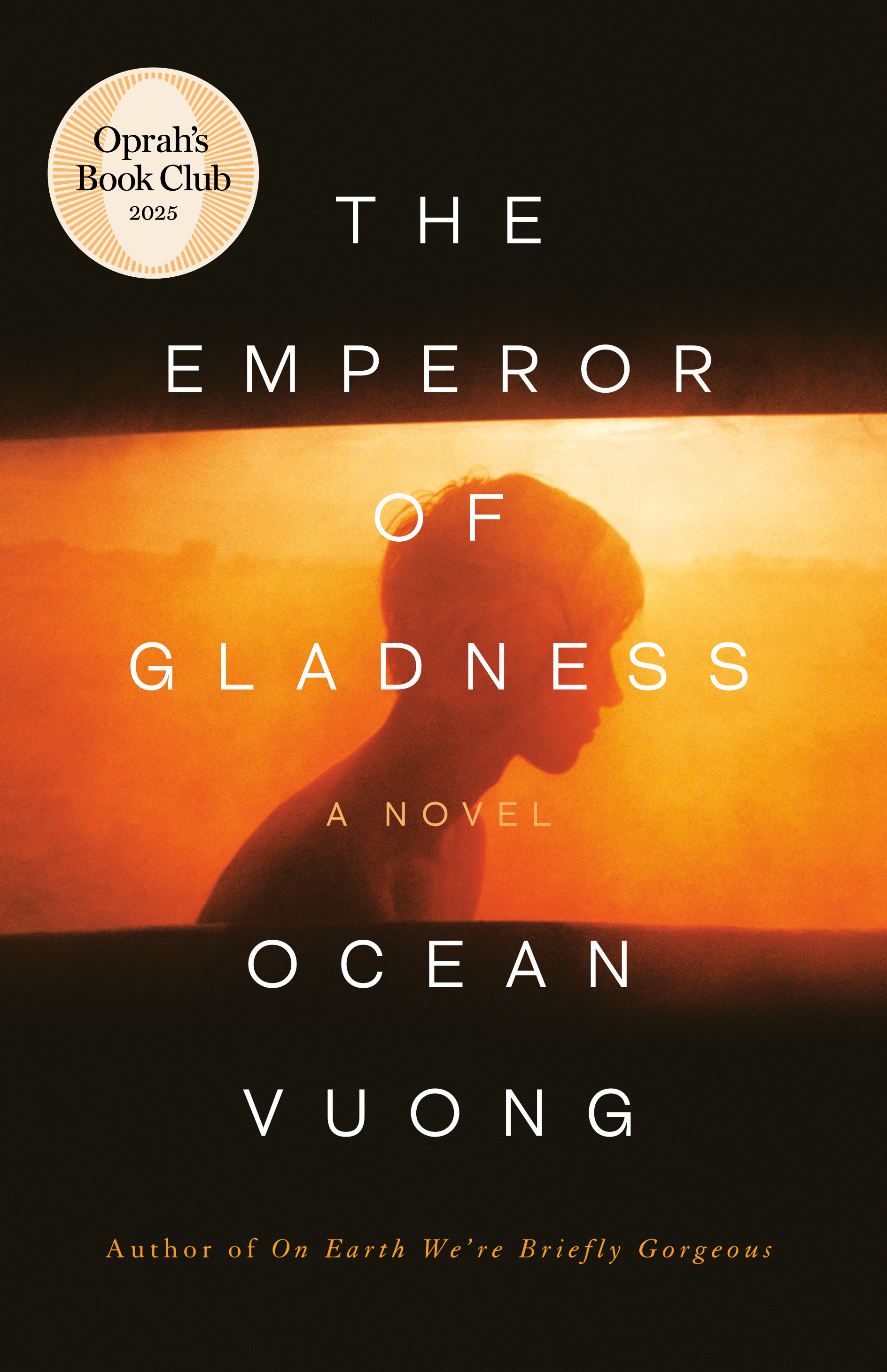
Written by Stephen Hong Sohn
Edited by Sam Higgins
At the tail end of my sabbatical, I fell off reviewing things consistently after reading the book. Thus, I come to reviewing Ocean Vuong’s Emperor of Gladness (Penguin Press, 2025) quite a long time after completing it. As many of us know, Vuong has reached a level of mainstream success that is not always common for any American writer. This book, in particular, is an Oprah’s Book Club selection! In any case, let’s let the official marketing description do some work for us: “One late summer evening in the post-industrial town of East Gladness, Connecticut, nineteen-year-old Hai stands on the edge of a bridge in pelting rain, ready to jump, when he hears someone shout across the river. The voice belongs to Grazina, an elderly widow succumbing to dementia, who convinces him to take another path. Bereft and out of options, he quickly becomes her caretaker. Over the course of the year, the unlikely pair develops a life-altering bond, one built on empathy, spiritual reckoning, and heartbreak, with the power to transform Hai’s relationship to himself, his family, and a community on the brink. Following the cycles of history, memory, and time, The Emperor of Gladness shows the profound ways in which love, labor, and loneliness form the bedrock of American life. At its heart is a brave epic about what it means to exist on the fringes of society and to reckon with the wounds that haunt our collective soul. Hallmarks of Ocean Vuong’s writing—formal innovation, syntactic dexterity, and the ability to twin grit with grace through tenderness—are on full display in this story of loss, hope, and how far we would go to possess one of life’s most fleeting mercies: a second chance.” What I absolutely adore about this novel is that it focuses on friendships, even as the text clearly is anchored by a queer Asian American character. This novel is absolutely masterful in how it tracks how Hai attempts to make a new life in the shadows of a lie he has told his mother, and the fact that he still somehow has to make ends meet. Enter Grazina, the grizzled widow suffering from dementia, who helps give Hai a purpose and also gives him a place to stay. Though Grazina’s home is dilapidated, Hai is able to construct a makeshift life, gets a job at a local fast food joint, where he sustains an alternative kinship amongst his cousin, Sony; the store manager, BJ, who dreams of becoming a wrestler; and others, like Maureen, who lost her young child. Vuong’s novel is realist at its core, even with its semi-utopian impulses, so we know that the merry band of workers will have its struggles. Despite the occasional bleakness of this crumbling place, Vuong’s ending suffuses us with the critical and life-saving import of the unexpected connections we make.
Buy the Book Here.


