![[identity profile]](https://www.dreamwidth.org/img/silk/identity/openid.png) stephenhongsohn.livejournal.com posting in
stephenhongsohn.livejournal.com posting in ![[community profile]](https://www.dreamwidth.org/img/silk/identity/community.png) asianamlitfans
asianamlitfansAsian American Literature Fans: Picture Book Megareview for July 13, 2012
Apologies: I’ve been attempting to balance professional obligations with reviewing lately and have been failing rather miserably. In this post, I focus on a selection of children’s picture books, including: Allen Say’s A River Dream (Sandpiper, 1993); Allen Say’s Grandfather’s Journey (Sandpiper, 1993); Allen Say’s The Sign Painter (Houghton Mifflin Children’s, 2000); Allen Say’s Emma’s Rug (Sandpiper, 2003); Music for Alice (Sandpiper, 2004); Allen Say’s Kamishibai Man (Sandpiper, 2005); Janet S. Wong’s Apple Pie on the Fourth of July (with illustrations by Margaret Chodos-Irvine) (Sandpiper, 2006); Susan Miho Nunes’s The Last Dragon (with illustrations by Chris K. Soentpiet) (Sandpiper, 1997); Linda Sue Park’s The Third Gift (will illustrations by Bagram Ibatoulline) (Clarion Books, 2007); Linda Sue Park’s The Firekeeper’s Son (with illustrations by Julie Downing) (Sandpiper, 2009); Linda Sue Park’s What Does Bunny See (with pictures by Maggie Smith) (Clarion Books, 2005); Linda Sue Park’s Tap Dancing on the Roof: Sijo (with pictures by Istvan Banyai) (Clarion Books, 2007); Linda Sue Park’s Bee-Bim Bop! (with pictures by Ho Baek Lee) (Sandpiper, 2008).
A Review of Allen Say’s A River Dream (Sandpiper, 1993); Grandfather’s Journey (Sandpiper, 1993); The Sign Painter (Houghton Mifflin Children’s, 2000); Emma’s Rug (Sandpiper, 2003); Music for Alice (Sandpiper, 2004); Kamishibai Man (Sandpiper, 2005).
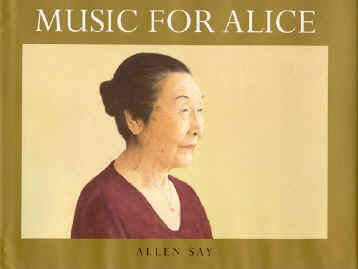
In Music for Alice, Say takes on a biographical subject, telling a condensed version of Alice Sumida’s life. For a biography of Alice Sumida, please go here:
http://www.discovernikkei.org/en/interviews/profiles/46/
This particular biographical condensation also happens to be a relatively excellent summation of the parts of Alice’s life that Say chooses to represent. Of course, what words cannot always convey, Say’s amazing watercolors help fill in the story. For instance, after helping out in the beet fields, Alice and her husband Mark choose to stay in the local area and to focus on farming. They first look to create food crops, but this tactic does not work well as they produce crops similar to other farmers in the area, creating an overabundance of supply. Mark and Alice worry that they will not be able to pay back the loans they took to start their farming. The challenges that they will face are acutely illustrated in the depiction of the first home, which has holes in the wooden roof and shoddy construction, yet Alice believes that they will be able to make the home into a “palace.” The sections focused on gladiola farming give Say an incredible opportunity to open up the page into a vast and beautiful field of colors. These paintings were some of my favorites that I’ve seen Say produce. It’s difficult to condense a full life into 32 pages and there are certainly points that could have used a little bit more fleshing out, but given the limitations of this “genre” and “form” Say has done an outstanding job.

For Grandfather’s Journey, Allen Say won the Caldecott Medal, which I believe to be one of the highest honors that a children’s book writer can receive. It’s easy to see why. In this auto/biographical book, Say explores the hyphenated identity of the immigrant subject. His grandfather travels to the United States, explores the many facets of the country, traveling through many areas, but eventually chooses to settle along the Pacific Coast. Though he loves many things about his adopted country, he is still homesick and moves his family (with an older teenage daughter, the one who would be the main character from Tea with Milk) back to Japan. The story eventually shifts to an exploration of Say’s own journey to the United States and his revelations concerning his own homesickness; the narrative ends with Say’s identification with his grandfather, understanding what it means to have an attachment to two places, two countries, two cultures, and two landscapes. As with all of his works, the watercolors are always so detailed and so exquisite. Many of the illustrations here take advantage of the way that Say can transform basic colors and use them to make landscapes come to life. After reading and “watching” so many of his works, it is easy to see the influence of still life and landscape painting to his work.

After Home of the Brave, The Sign Painter was probably my favorite story and illustrated book that I’ve read/seen of Say’s. In The Sign Painter, the titular character takes a job painting a woman’s portrait on large billboards to help sell a particular product. He is unsure of what that product is, but he is commissioned to complete a number of these billboards which appear in various desert locales across the American southwest. The regional geography of this work allows Say the opportunity to paint some of the most stunning landscape watercolors that I’ve seen. There is one panel which shows a cloud drifting into the blasted out rectangular frame of a billboard—literally, a panel of a panel—melding representation and reality together in a beautiful meta-artistic moment. There is also a wonderful and slightly surreal quality of this work as the main character ends up realizing that the billboard is intended to help promote a roller coaster built out in the desert. In one panel, the billboard simply emerges ominously out of the desert landscape, towering above a plateau and outcropping of houses. The austerity and cruel beauty of the American Southwest is on full display here and it reminds me of some of the trips I managed to take as an undergraduate to these areas during Alternative Spring Breaks.
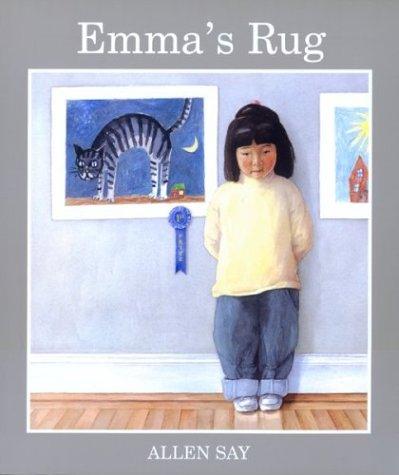
Emma’s Rug takes on a topic similar to The Sign Painter, but shifts it back to an artist’s development in childhood years. The young Emma—she seems to be around five years old—is a particularly talented painter and artist, but her inspiration for her many depictions comes from a rather odd location. That is, she spends her time staring into a rug (the titular rug) almost as if it is a television set. The rug acts in a fashion much like Linus’s blanket from the Peanuts. She goes everywhere with it and finds it to be an incredible source of security. Emma begins to win many awards and at one point is feted with her own celebration after having been crowned champion of a prestigious contest. But one day Emma’s rug is washed and Emma is incredibly heartbroken and angry and believes her rug to have lost its powers of inspiration. The conclusion sees her discovering that the artist’s voice and soul can be found all around her and the last panel sees her drawing again.

A River Dream takes on the surrealistic tone that I’ve come to appreciate in Say’s work overall. A young boy is sick, but soon he sees something outside his window—a river that was not there before and he exits the window in order to investigate it. This adventure becomes an opportunity for the sick boy to explore one of his interests—he sees his uncle on a boat downstream and goes to him, where they proceed to fish together. The young boy begins to learn some basics about fishing. For instance, his uncle never actually keeps the fish that he catches, choosing instead to release them back into the water. Once the boy finally snags a fish, he wants to keep it, but when the uncle tells him he must kill it, the boy decides to release the fish. The ending sequence sees him return home, but it is not entirely clear about the veracity of what he experienced given his sickness. Was it all a dream or something more?

Kamishibai Man focuses on a particular artistic tradition in Japan that experienced a major revival during the 1920s, a period of severe economic depression. Kamishibai is essentially a mode of storytelling using pictures and hand-made objects to create sounds. Individuals could take up a job as a kamishibai artist to make more money, but over time and with the advent of new technologies, the tradition of kamishibai eventually faded out. In Say’s story, he explores the life of an aged man who goes out on the road to entertain some children. There is a surreal quality to the story as the village he is used to has given way to some more modern urban center and the kids that found his stories so inviting do not seem to be as interested in what he has to say. It becomes clear that the grandfather has experienced some sort of time lapse—or at least that is one explanation—and that children in this technologically savvy age seemed to have moved on, except for the fact that the adults do indeed remember how much they enjoyed his stories as children. Thus, the conclusion sees the kamishibai man resolved to continue with this art!
After having gone through about a dozen of Allen Say’s works, I’m convinced that I will have to add something related to what has been called the “picture book” to future courses. Many of the Say’s works tend to implicitly reference race, which I think is an interesting tactic. For instance, in both Emma’s Rug and A River Dream, the pictures suggest that the main characters could be of Asian descent, but it’s never definitively denoted. Does it matter that we know the racial backgrounds of these characters? I think such a question could make for an interesting discussion. Of course, I look forward and hope that Allen Say continues to produce many more picture books as I am definitely a fan!
Buy the Books Here:
http://www.amazon.com/Music-Alice-Allen-Say/dp/0618311181/ref=sr_1_1?ie=UTF8&qid=1335972911&sr=8-1
http://www.amazon.com/Grandfathers-Journey-Allen-Say/dp/0547076800/ref=sr_1_4?ie=UTF8&qid=1336157019&sr=8-4
http://www.amazon.com/The-Sign-Painter-Allen-Say/dp/0395979749/ref=la_B000APMWKQ_1_13?ie=UTF8&qid=1336157472&sr=1-13
http://www.amazon.com/Emmas-Rug-Allen-Say/dp/0618335234/ref=sr_1_1?ie=UTF8&qid=1336662992&sr=8-1
http://www.amazon.com/A-River-Dream-Allen-Say/dp/0395657490/ref=sr_1_1?ie=UTF8&qid=1336663733&sr=8-1
http://www.amazon.com/Kamishibai-Man-Allen-Say/dp/0618479546/ref=sr_1_8?ie=UTF8&qid=1336785273&sr=8-8
A Review of Janet S. Wong’s Apple Pie on the Fourth of July (with illustrations by Margaret Chodos-Irvine) (Sandpiper, 2006); Susan Miho Nunes’s The Last Dragon (with illustrations by Chris K. Soentpiet) (Sandpiper, 1997); Linda Sue Park’s The Third Gift (will illustrations by Bagram Ibatoulline) (Clarion Books, 2007); Linda Sue Park’s The Firekeeper’s Son (with illustrations by Julie Downing) (Sandpiper, 2009); Linda Sue Park’s What Does Bunny See (with pictures by Maggie Smith) (Clarion Books, 2005); Linda Sue Park’s Tap Dancing on the Roof: Sijo (with pictures by Istvan Banyai) (Clarion Books, 2007); Linda Sue Park’s Bee-Bim Bop! (with pictures by Ho Baek Lee) (Sandpiper, 2008).

Janet S. Wong’s Apple Pie on the Fourth of July is another ethnically themed children’s picture book that is about racialized shame and the possibilities of overcoming them (recall Suki’s Kimono which was earlier reviewed). In this particular story, a young Chinese American girl laments having to work in her parents’ Chinese food restaurant on the July 4th, a holiday that she believes is characterized by things like apple pie rather than the kinds of cuisine her parents are selling. As the day goes by, the restaurant does little business and the girl’s mood seems to darken. However, around evening, business begins to pick up and by dinner time there are many customers walking through the door to purchase the very food that she had been denigrating as an unworthy cuisine to be consuming on July 4th. The conclusion sees the family going to watch fire works and the little girl able to consume a slice of apple pie. Wong’s message is clearly one related to a multicultural ethos: no one gourmet can be suitable to characterize a holiday. The more difficult topic of racial shame would be a challenging subject to discuss with the target audience. The illustrations are especially compelling as Chodos-Irvine focuses on a large “block like” style that gives the characters and settings a geometric look.

Susan Miho Nunes’s The Last Dragon was the first picture book I read that included major text blocks alongside pictures and illustrations (as a side note, the watercolors by Soentpiet are particularly noteworthy with their lovely impressionistic style). Like Wong’s story, this one has a Chinese ethnic context. In this case, a young Chinese American boy is sent to live with his great aunt in Chinatown. He’s not very excited until, that is, he is in a shop and observes a raggedy, but nevertheless interesting looking dragon, the kind which might be seen in ethnic parades. He wants the dragon very badly, though his great aunt seems skeptical that such a dragon is worthy of any adoration. Together, they see the dragon as a project and the great aunt helps the little boy employ all the resources of the Chinatown community to patch the dragon back together. They visit the local tailor, kite maker, and apothecary, all in the hopes of restoring the dragon to its former glory. The great aunt’s mahjahng club also contributes by creating a majestic dragon’s crest. I could see one of the problems with this particular picture book might be that the illustrations occasionally take a backseat to the narrative and young audiences might find themselves a little bit attention-challenged by staying on one panel and page for too long. Like Apple Pie on the Fourth of July, The Last Dragon reveals a young child who must find a way to lift his spirits vis-à-vis coming to terms with an ethnic context and even to find pride in it.

The Firekeeper’s Son was the first picture book I’ve read by Linda Sue Park. It’s impressive to see Park move between genres here, but it’s clear that storytelling is but one part of this form. The wonderful illustrations by Julie Downing provide the necessary components to bring this story alive. In this work, Park takes on the historical context of Korean defense systems employed in the past whereby bonfires were lit atop mountains to signal and to communicate with other parts of the country. The author’s note that accompanies the conclusion of the picture book details a little bit more about this process. In any case, the actual story is rooted in a domestic context as the titular character must take on the job that was originally tasked to his father when it is discovered that his father has injured his ankle and is unable to light the fire. Thus, the young boy, though losing an occasional coal here and there, is able to provide the signal that all is fine within their region of Korea.
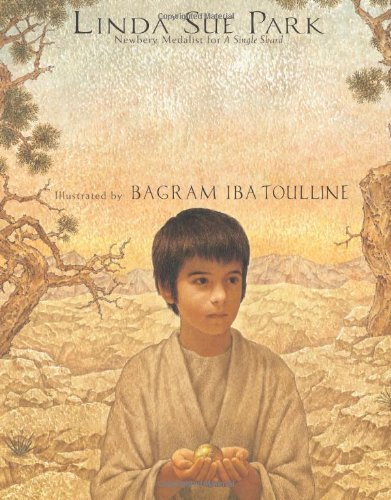
In The Third Gift, Park takes on the Christian religious context of the three wise men and details the life of a father and his son as they work to tap trees of a particular resin. What the readers do not know is what kind of tree these really are and it becomes evident by the conclusion that the trees are secreting what is commonly known as myrrh resin. The myrrh resin as the story goes on to note can be used in a variety of different ways, including funereal rituals and as part of health ointments and treatments. At one point, they are able to tap a very large and very rare myrrh bead, which will later (of course) used as part of the gifts that will be given to herald the birth of baby Jesus. Perhaps most notable about this work is the illustrations. Ibatoulline opts for a hyper-real style that gives a more photographic appearance to any human figures that appear within a given frame; the contrast against the more impressionistic environment is particularly stark and the characters pop off out of the page. I wondered, though, about how children might gravitate toward this pictorial approach in contrast to what might be considered to be the more popular cartoonish style that is more evident in the work of Downing (in The Firekeeper’s Son) and Chodos-Irvine (in Apple Pie on the Fourth of July).

Linda Sue Park’s What Does Bunny See? is an interesting amalgamation of the picture book and lyric poetry (at least broadly defined). The titular bunny is our point of identification here, as he bounds from one part of the garden to another to come upon different plants. The subtitle to this book is “a book of colors,” as one color corresponds to a particular type of flower or flora: red for scarlet poppies, yellow for primroses, purple for violets, green for grass, pink for water lily blooms, orange for tiger lilies, and blue for morning glories. The pictures are all very engaging with a very fun cartoonish style that young children are sure to love. The use of the lyric is inventive in so far as Park makes use of off rhymes and full rhymes to give the text a very performative quality. You can easily see the book being read allowed to a classroom full of young students.
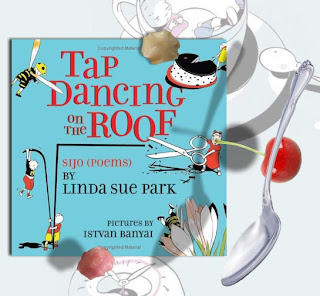
Linda Sue Park’s Tap Dancing on the Roof is another exploration in a multidisciplinary picture books, combining images in this case with a very specific Korean poetic form known as the sijo. The English language variation of the sijo can, of course, only be an approximation, but Park has fun with her lyrics. The utility of the sijo, insofar as it connects to children’s picture books, is that the form requires a kind of turn or joke toward the end, so it becomes something quite inventive and fun to read and obviously can appeal as a poetic form toward younger audiences. The pictures that accompany the poems are always first-rate and Banyai’s images are nice and geometrically configured.
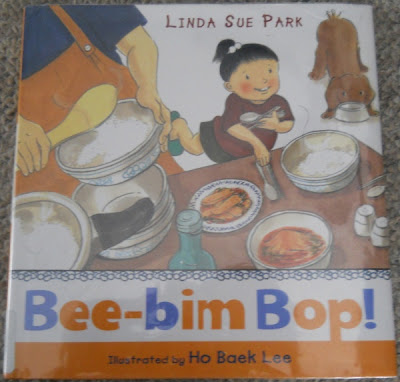
Linda Sue Park’s Bee-Bim Bop! takes on a gastronomic topic that is one of my personal favorites: the popular Korean dish named in the children’s books title. Yes, “bibimbap” as I like to call it, which is a mishmash of various things including rice, egg, kimchi, various shoots, roots, and vegetables, sometimes some beef, spicy sauce, and you stir it all together (sometimes in a hot clay pot) and voila, the perfect Korean meal. Haha! =) In any case, this children’s picture book comes off as a kind of adventure for a family planning to construct their own meal of “bee-bim bop,” and the book even includes a recipe at the conclusion. The one thing remains rather implicit in Park’s work is ethnicity in this book. I believe we are meant to read the family that is at the heart of the narrative as Korean, but we’re never given much information about them. I still find the use of race and ethnicity in children’s picture books to be interesting. It’s clear that the writers are cognizant of various differences, but often avoid directly exploring them in textual content.
Buy the Books Here:
http://www.amazon.com/Apple-Fourth-July-Janet-Wong/dp/0152057080/ref=sr_1_1?ie=UTF8&qid=1338304719&sr=8-1
http://www.amazon.com/Last-Dragon-Susan-Miho-Nunes/dp/0395845173/ref=sr_1_1?s=books&ie=UTF8&qid=1338304780&sr=1-1
http://www.amazon.com/The-Third-Gift-Linda-Park/dp/0547201958/ref=sr_1_5?ie=UTF8&qid=1338392774&sr=8-5
http://www.amazon.com/The-Firekeepers-Son-Linda-Park/dp/0547237693/ref=sr_1_1?s=books&ie=UTF8&qid=1338392854&sr=1-1
http://www.amazon.com/Tap-Dancing-Roof-Sijo-Poems/dp/B006TQWQWY/ref=sr_1_24?ie=UTF8&qid=1341963612&sr=8-24&keywords=Linda+sue+Park
http://www.amazon.com/Bee-Bim-Bop-Linda-Sue-Park/dp/0547076711/ref=sr_1_1?s=books&ie=UTF8&qid=1341963771&sr=1-1&keywords=Bi+Bim+Bop
Apologies: I’ve been attempting to balance professional obligations with reviewing lately and have been failing rather miserably. In this post, I focus on a selection of children’s picture books, including: Allen Say’s A River Dream (Sandpiper, 1993); Allen Say’s Grandfather’s Journey (Sandpiper, 1993); Allen Say’s The Sign Painter (Houghton Mifflin Children’s, 2000); Allen Say’s Emma’s Rug (Sandpiper, 2003); Music for Alice (Sandpiper, 2004); Allen Say’s Kamishibai Man (Sandpiper, 2005); Janet S. Wong’s Apple Pie on the Fourth of July (with illustrations by Margaret Chodos-Irvine) (Sandpiper, 2006); Susan Miho Nunes’s The Last Dragon (with illustrations by Chris K. Soentpiet) (Sandpiper, 1997); Linda Sue Park’s The Third Gift (will illustrations by Bagram Ibatoulline) (Clarion Books, 2007); Linda Sue Park’s The Firekeeper’s Son (with illustrations by Julie Downing) (Sandpiper, 2009); Linda Sue Park’s What Does Bunny See (with pictures by Maggie Smith) (Clarion Books, 2005); Linda Sue Park’s Tap Dancing on the Roof: Sijo (with pictures by Istvan Banyai) (Clarion Books, 2007); Linda Sue Park’s Bee-Bim Bop! (with pictures by Ho Baek Lee) (Sandpiper, 2008).
A Review of Allen Say’s A River Dream (Sandpiper, 1993); Grandfather’s Journey (Sandpiper, 1993); The Sign Painter (Houghton Mifflin Children’s, 2000); Emma’s Rug (Sandpiper, 2003); Music for Alice (Sandpiper, 2004); Kamishibai Man (Sandpiper, 2005).
In Music for Alice, Say takes on a biographical subject, telling a condensed version of Alice Sumida’s life. For a biography of Alice Sumida, please go here:
http://www.discovernikkei.org/en/interviews/profiles/46/
This particular biographical condensation also happens to be a relatively excellent summation of the parts of Alice’s life that Say chooses to represent. Of course, what words cannot always convey, Say’s amazing watercolors help fill in the story. For instance, after helping out in the beet fields, Alice and her husband Mark choose to stay in the local area and to focus on farming. They first look to create food crops, but this tactic does not work well as they produce crops similar to other farmers in the area, creating an overabundance of supply. Mark and Alice worry that they will not be able to pay back the loans they took to start their farming. The challenges that they will face are acutely illustrated in the depiction of the first home, which has holes in the wooden roof and shoddy construction, yet Alice believes that they will be able to make the home into a “palace.” The sections focused on gladiola farming give Say an incredible opportunity to open up the page into a vast and beautiful field of colors. These paintings were some of my favorites that I’ve seen Say produce. It’s difficult to condense a full life into 32 pages and there are certainly points that could have used a little bit more fleshing out, but given the limitations of this “genre” and “form” Say has done an outstanding job.
For Grandfather’s Journey, Allen Say won the Caldecott Medal, which I believe to be one of the highest honors that a children’s book writer can receive. It’s easy to see why. In this auto/biographical book, Say explores the hyphenated identity of the immigrant subject. His grandfather travels to the United States, explores the many facets of the country, traveling through many areas, but eventually chooses to settle along the Pacific Coast. Though he loves many things about his adopted country, he is still homesick and moves his family (with an older teenage daughter, the one who would be the main character from Tea with Milk) back to Japan. The story eventually shifts to an exploration of Say’s own journey to the United States and his revelations concerning his own homesickness; the narrative ends with Say’s identification with his grandfather, understanding what it means to have an attachment to two places, two countries, two cultures, and two landscapes. As with all of his works, the watercolors are always so detailed and so exquisite. Many of the illustrations here take advantage of the way that Say can transform basic colors and use them to make landscapes come to life. After reading and “watching” so many of his works, it is easy to see the influence of still life and landscape painting to his work.
After Home of the Brave, The Sign Painter was probably my favorite story and illustrated book that I’ve read/seen of Say’s. In The Sign Painter, the titular character takes a job painting a woman’s portrait on large billboards to help sell a particular product. He is unsure of what that product is, but he is commissioned to complete a number of these billboards which appear in various desert locales across the American southwest. The regional geography of this work allows Say the opportunity to paint some of the most stunning landscape watercolors that I’ve seen. There is one panel which shows a cloud drifting into the blasted out rectangular frame of a billboard—literally, a panel of a panel—melding representation and reality together in a beautiful meta-artistic moment. There is also a wonderful and slightly surreal quality of this work as the main character ends up realizing that the billboard is intended to help promote a roller coaster built out in the desert. In one panel, the billboard simply emerges ominously out of the desert landscape, towering above a plateau and outcropping of houses. The austerity and cruel beauty of the American Southwest is on full display here and it reminds me of some of the trips I managed to take as an undergraduate to these areas during Alternative Spring Breaks.
Emma’s Rug takes on a topic similar to The Sign Painter, but shifts it back to an artist’s development in childhood years. The young Emma—she seems to be around five years old—is a particularly talented painter and artist, but her inspiration for her many depictions comes from a rather odd location. That is, she spends her time staring into a rug (the titular rug) almost as if it is a television set. The rug acts in a fashion much like Linus’s blanket from the Peanuts. She goes everywhere with it and finds it to be an incredible source of security. Emma begins to win many awards and at one point is feted with her own celebration after having been crowned champion of a prestigious contest. But one day Emma’s rug is washed and Emma is incredibly heartbroken and angry and believes her rug to have lost its powers of inspiration. The conclusion sees her discovering that the artist’s voice and soul can be found all around her and the last panel sees her drawing again.
A River Dream takes on the surrealistic tone that I’ve come to appreciate in Say’s work overall. A young boy is sick, but soon he sees something outside his window—a river that was not there before and he exits the window in order to investigate it. This adventure becomes an opportunity for the sick boy to explore one of his interests—he sees his uncle on a boat downstream and goes to him, where they proceed to fish together. The young boy begins to learn some basics about fishing. For instance, his uncle never actually keeps the fish that he catches, choosing instead to release them back into the water. Once the boy finally snags a fish, he wants to keep it, but when the uncle tells him he must kill it, the boy decides to release the fish. The ending sequence sees him return home, but it is not entirely clear about the veracity of what he experienced given his sickness. Was it all a dream or something more?
Kamishibai Man focuses on a particular artistic tradition in Japan that experienced a major revival during the 1920s, a period of severe economic depression. Kamishibai is essentially a mode of storytelling using pictures and hand-made objects to create sounds. Individuals could take up a job as a kamishibai artist to make more money, but over time and with the advent of new technologies, the tradition of kamishibai eventually faded out. In Say’s story, he explores the life of an aged man who goes out on the road to entertain some children. There is a surreal quality to the story as the village he is used to has given way to some more modern urban center and the kids that found his stories so inviting do not seem to be as interested in what he has to say. It becomes clear that the grandfather has experienced some sort of time lapse—or at least that is one explanation—and that children in this technologically savvy age seemed to have moved on, except for the fact that the adults do indeed remember how much they enjoyed his stories as children. Thus, the conclusion sees the kamishibai man resolved to continue with this art!
After having gone through about a dozen of Allen Say’s works, I’m convinced that I will have to add something related to what has been called the “picture book” to future courses. Many of the Say’s works tend to implicitly reference race, which I think is an interesting tactic. For instance, in both Emma’s Rug and A River Dream, the pictures suggest that the main characters could be of Asian descent, but it’s never definitively denoted. Does it matter that we know the racial backgrounds of these characters? I think such a question could make for an interesting discussion. Of course, I look forward and hope that Allen Say continues to produce many more picture books as I am definitely a fan!
Buy the Books Here:
http://www.amazon.com/Music-Alice-Allen-Say/dp/0618311181/ref=sr_1_1?ie=UTF8&qid=1335972911&sr=8-1
http://www.amazon.com/Grandfathers-Journey-Allen-Say/dp/0547076800/ref=sr_1_4?ie=UTF8&qid=1336157019&sr=8-4
http://www.amazon.com/The-Sign-Painter-Allen-Say/dp/0395979749/ref=la_B000APMWKQ_1_13?ie=UTF8&qid=1336157472&sr=1-13
http://www.amazon.com/Emmas-Rug-Allen-Say/dp/0618335234/ref=sr_1_1?ie=UTF8&qid=1336662992&sr=8-1
http://www.amazon.com/A-River-Dream-Allen-Say/dp/0395657490/ref=sr_1_1?ie=UTF8&qid=1336663733&sr=8-1
http://www.amazon.com/Kamishibai-Man-Allen-Say/dp/0618479546/ref=sr_1_8?ie=UTF8&qid=1336785273&sr=8-8
A Review of Janet S. Wong’s Apple Pie on the Fourth of July (with illustrations by Margaret Chodos-Irvine) (Sandpiper, 2006); Susan Miho Nunes’s The Last Dragon (with illustrations by Chris K. Soentpiet) (Sandpiper, 1997); Linda Sue Park’s The Third Gift (will illustrations by Bagram Ibatoulline) (Clarion Books, 2007); Linda Sue Park’s The Firekeeper’s Son (with illustrations by Julie Downing) (Sandpiper, 2009); Linda Sue Park’s What Does Bunny See (with pictures by Maggie Smith) (Clarion Books, 2005); Linda Sue Park’s Tap Dancing on the Roof: Sijo (with pictures by Istvan Banyai) (Clarion Books, 2007); Linda Sue Park’s Bee-Bim Bop! (with pictures by Ho Baek Lee) (Sandpiper, 2008).
Janet S. Wong’s Apple Pie on the Fourth of July is another ethnically themed children’s picture book that is about racialized shame and the possibilities of overcoming them (recall Suki’s Kimono which was earlier reviewed). In this particular story, a young Chinese American girl laments having to work in her parents’ Chinese food restaurant on the July 4th, a holiday that she believes is characterized by things like apple pie rather than the kinds of cuisine her parents are selling. As the day goes by, the restaurant does little business and the girl’s mood seems to darken. However, around evening, business begins to pick up and by dinner time there are many customers walking through the door to purchase the very food that she had been denigrating as an unworthy cuisine to be consuming on July 4th. The conclusion sees the family going to watch fire works and the little girl able to consume a slice of apple pie. Wong’s message is clearly one related to a multicultural ethos: no one gourmet can be suitable to characterize a holiday. The more difficult topic of racial shame would be a challenging subject to discuss with the target audience. The illustrations are especially compelling as Chodos-Irvine focuses on a large “block like” style that gives the characters and settings a geometric look.
Susan Miho Nunes’s The Last Dragon was the first picture book I read that included major text blocks alongside pictures and illustrations (as a side note, the watercolors by Soentpiet are particularly noteworthy with their lovely impressionistic style). Like Wong’s story, this one has a Chinese ethnic context. In this case, a young Chinese American boy is sent to live with his great aunt in Chinatown. He’s not very excited until, that is, he is in a shop and observes a raggedy, but nevertheless interesting looking dragon, the kind which might be seen in ethnic parades. He wants the dragon very badly, though his great aunt seems skeptical that such a dragon is worthy of any adoration. Together, they see the dragon as a project and the great aunt helps the little boy employ all the resources of the Chinatown community to patch the dragon back together. They visit the local tailor, kite maker, and apothecary, all in the hopes of restoring the dragon to its former glory. The great aunt’s mahjahng club also contributes by creating a majestic dragon’s crest. I could see one of the problems with this particular picture book might be that the illustrations occasionally take a backseat to the narrative and young audiences might find themselves a little bit attention-challenged by staying on one panel and page for too long. Like Apple Pie on the Fourth of July, The Last Dragon reveals a young child who must find a way to lift his spirits vis-à-vis coming to terms with an ethnic context and even to find pride in it.
The Firekeeper’s Son was the first picture book I’ve read by Linda Sue Park. It’s impressive to see Park move between genres here, but it’s clear that storytelling is but one part of this form. The wonderful illustrations by Julie Downing provide the necessary components to bring this story alive. In this work, Park takes on the historical context of Korean defense systems employed in the past whereby bonfires were lit atop mountains to signal and to communicate with other parts of the country. The author’s note that accompanies the conclusion of the picture book details a little bit more about this process. In any case, the actual story is rooted in a domestic context as the titular character must take on the job that was originally tasked to his father when it is discovered that his father has injured his ankle and is unable to light the fire. Thus, the young boy, though losing an occasional coal here and there, is able to provide the signal that all is fine within their region of Korea.
In The Third Gift, Park takes on the Christian religious context of the three wise men and details the life of a father and his son as they work to tap trees of a particular resin. What the readers do not know is what kind of tree these really are and it becomes evident by the conclusion that the trees are secreting what is commonly known as myrrh resin. The myrrh resin as the story goes on to note can be used in a variety of different ways, including funereal rituals and as part of health ointments and treatments. At one point, they are able to tap a very large and very rare myrrh bead, which will later (of course) used as part of the gifts that will be given to herald the birth of baby Jesus. Perhaps most notable about this work is the illustrations. Ibatoulline opts for a hyper-real style that gives a more photographic appearance to any human figures that appear within a given frame; the contrast against the more impressionistic environment is particularly stark and the characters pop off out of the page. I wondered, though, about how children might gravitate toward this pictorial approach in contrast to what might be considered to be the more popular cartoonish style that is more evident in the work of Downing (in The Firekeeper’s Son) and Chodos-Irvine (in Apple Pie on the Fourth of July).
Linda Sue Park’s What Does Bunny See? is an interesting amalgamation of the picture book and lyric poetry (at least broadly defined). The titular bunny is our point of identification here, as he bounds from one part of the garden to another to come upon different plants. The subtitle to this book is “a book of colors,” as one color corresponds to a particular type of flower or flora: red for scarlet poppies, yellow for primroses, purple for violets, green for grass, pink for water lily blooms, orange for tiger lilies, and blue for morning glories. The pictures are all very engaging with a very fun cartoonish style that young children are sure to love. The use of the lyric is inventive in so far as Park makes use of off rhymes and full rhymes to give the text a very performative quality. You can easily see the book being read allowed to a classroom full of young students.
Linda Sue Park’s Tap Dancing on the Roof is another exploration in a multidisciplinary picture books, combining images in this case with a very specific Korean poetic form known as the sijo. The English language variation of the sijo can, of course, only be an approximation, but Park has fun with her lyrics. The utility of the sijo, insofar as it connects to children’s picture books, is that the form requires a kind of turn or joke toward the end, so it becomes something quite inventive and fun to read and obviously can appeal as a poetic form toward younger audiences. The pictures that accompany the poems are always first-rate and Banyai’s images are nice and geometrically configured.
Linda Sue Park’s Bee-Bim Bop! takes on a gastronomic topic that is one of my personal favorites: the popular Korean dish named in the children’s books title. Yes, “bibimbap” as I like to call it, which is a mishmash of various things including rice, egg, kimchi, various shoots, roots, and vegetables, sometimes some beef, spicy sauce, and you stir it all together (sometimes in a hot clay pot) and voila, the perfect Korean meal. Haha! =) In any case, this children’s picture book comes off as a kind of adventure for a family planning to construct their own meal of “bee-bim bop,” and the book even includes a recipe at the conclusion. The one thing remains rather implicit in Park’s work is ethnicity in this book. I believe we are meant to read the family that is at the heart of the narrative as Korean, but we’re never given much information about them. I still find the use of race and ethnicity in children’s picture books to be interesting. It’s clear that the writers are cognizant of various differences, but often avoid directly exploring them in textual content.
Buy the Books Here:
http://www.amazon.com/Apple-Fourth-July-Janet-Wong/dp/0152057080/ref=sr_1_1?ie=UTF8&qid=1338304719&sr=8-1
http://www.amazon.com/Last-Dragon-Susan-Miho-Nunes/dp/0395845173/ref=sr_1_1?s=books&ie=UTF8&qid=1338304780&sr=1-1
http://www.amazon.com/The-Third-Gift-Linda-Park/dp/0547201958/ref=sr_1_5?ie=UTF8&qid=1338392774&sr=8-5
http://www.amazon.com/The-Firekeepers-Son-Linda-Park/dp/0547237693/ref=sr_1_1?s=books&ie=UTF8&qid=1338392854&sr=1-1
http://www.amazon.com/Tap-Dancing-Roof-Sijo-Poems/dp/B006TQWQWY/ref=sr_1_24?ie=UTF8&qid=1341963612&sr=8-24&keywords=Linda+sue+Park
http://www.amazon.com/Bee-Bim-Bop-Linda-Sue-Park/dp/0547076711/ref=sr_1_1?s=books&ie=UTF8&qid=1341963771&sr=1-1&keywords=Bi+Bim+Bop


![[personal profile]](https://www.dreamwidth.org/img/silk/identity/user.png)
no subject
Date: 2012-07-14 01:47 pm (UTC)And yay for Allen Say! I'll definitely look up the Sign Painter. I'm especially curious about that meta-artistic image you mention. And I didn't realize Linda Sue Park had written that many picture books!
no subject
Date: 2012-07-15 04:30 pm (UTC)i sort of failed a promise to myself to post once a week, so i think it's just this weird self policing aspect going on there
sign painter is awesome!!! you will lurve it
Buy miserly tabs no prescription
Date: 2017-01-09 08:39 am (UTC)[url=http://pharmshop-online.com]generic cialis[/url] cialis, uk
generic cialis (http://pharmshop-online.com) - cialis 20 mg cost password
cialis precautions