![[identity profile]](https://www.dreamwidth.org/img/silk/identity/openid.png) stephenhongsohn.livejournal.com posting in
stephenhongsohn.livejournal.com posting in ![[community profile]](https://www.dreamwidth.org/img/silk/identity/community.png) asianamlitfans
asianamlitfansAsian American Literature Fans – Megareview review for May 27, 2010: Allen Say spotlight (Part 1).
A Review of Allen Say’s Tree of Cranes (1991); The Boy of the Three-Year Nap (illustrated only, authored by Dianne Snyder, Sandpiper, 1993); Tea With Milk (Sandpiper, 1999); Home of the Brave (Sandpiper, 2002); and Allison (Sandpiper, 2004).
I’m really starting to enjoy reading children’s books as a form; of course, they are some commonalties to discuss among them: very short length (often around 32 to 40 pages), short text blocks accompanied with large pictures, and linear narratives that inexorably resolve. The topics and narratives that children’s book writers and illustrators tackle can obviously be severely limited based upon these genre concerns, which is why I’m impressed by Allen Say’s work as a whole. I read Say’s books out of order, so the logic of my review is going to reflect that order.

In Allison, for instance, Say tackles the topic of transracial adoption. The titular Allison has a doll named Mei-mei who looks like her, but not her adoptive parents. This moment, a mirror stage moment if you will, causes her to think about her identity and after discovering that she is indeed adopted, she proceeds to act out her issues by destroying particular objects—a Blonde Barbie doll for instance—that serve to complicate how she understands herself and her sense of family. The conclusion of the story sees her make a “passionate attachment” to a stray cat with whom she identifies because the cat also does not know where her parents are. The narrative basically ends here and you can’t help but think that the cat is but a temporary salve for a much larger issue Allison will have to deal with and of course, the story does not even begin to attempt to explore the larger social context dealing with the trafficking in human babies. Despite these shortcomings, Say’s work is commendable to exploring difficult topics; the texts and the images provide a starting point for larger conversations about the form and the politics of children’s literatures.
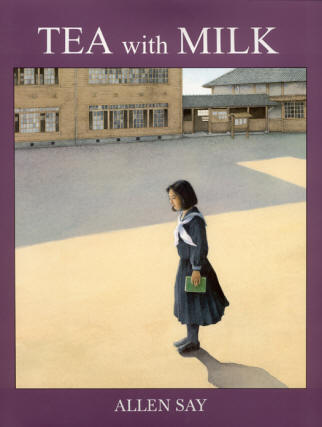
In Tea with Milk, Say also takes on a rather “adult” topic in the exploration of an older teenager named Masako (nicknamed May) who grows up in the United States, but later moves back with her family to Japan. She does not do well with the move and feels extremely alienated by Japanese culture and still prefers her “tea with milk.” Chafing against Japanese cultural norms that encourages her to marry young, May moves to the city to start a life on her own and works as a department store elevator girl and later as a hostess and tour guide. A man from Shanghai named Joseph (who was adopted) who can speak English becomes a good friend to May and they begin a tentative and sweet courtship. When he reveals that he has been transferred to Yokohama, both May and Joseph realize that they must make life altering decisions about whether or not they should stay together. As with Allison, this book deals with fairly complex issues: female independence in contemporary Japan and given the fact that Say was born in 1939 and this text is a biographically inflected work, we can’t help but think about Joseph’s colonial connections growing up in China.

Diane Snyder’s The Boy of the Three Year Nap was the first of Say’s collaborative publications I read. This work differs markedly from the dynamic and realist watercolors from Allison and Tea with Milk. Say experiments with a yukio-e inspired drawing style that compares favorably with the narrative context of Snyder’s story, which focuses on a young man Taro, who seeks to find a wife despite the fact that he is presumed to be lazy. He hatches a plan to frighten a local and wealthy merchant into believing that his daughter will be turned into a clay pot unless his daughter is married off to the widow’s son, who happens of course to be Taro himself. The brilliance of Snyder’s story is that the widow also has other plans for Taro and is able to get the merchant to improve their living situation (patching up the house and adding new rooms), but also forcing him to give Taro a job and thereby effectively ending his status as the local lazy man.

Tree of Cranes also focuses on a Japanese context. Its illustrations are reminiscent of the detailed watercolors found in Tea with Milk and Allison. The basic narrative revolves around a young Japanese boy who is out enjoying the winter weather, but when he returns home, he realizes that he is not feeling entirely well. His mother is also acting a little bit strangely and he’s unsure as to the reason. His mother puts him under a sickness regimen, which includes sitting in a steam bath and eating particularly unsavory foods. When he wakes up, he is feeling much better and he discovers the fact that his mother is making a Christmas tree, one that will be outfitted with paper cranes. The boy, unaware of the American holiday, comes to learn about the ritual of gift giving and delights in the beauty of the tree. This story is a rather self-contained narrative about the delicate relationship between a Japanese mother and her child; that the mother had once lived in California reminds us of the character of Masako from Tea with Milk, suggestive of the narrative’s more autobiographical leanings.

In Erika-San, Say depicts the life of the titular character first as a young girl, who is very much impressed with a particular photo and history related to her grandparents who once lived in Japan. Erika, who looks to be Caucasian, grows up cultivating her interest in Japan, learns the language, studies the culture, and eventually travels there with the intent to take on some sort of instructional position. Interestingly enough, she arrives in a major city and finds the atmosphere too claustrophobic and requests that she be transferred to another location, but the next location is still too busy for her and she finally ends up at a rural village and begins to make a life there. She establishes herself as the teacher and then also embarks on a romance with a local Japanese man. She coincidentally discovers the very same house that was depicted in a photo her grandmother had on the wall that spurred Erika’s initial interest in Japan. That house ends up being a tea house, which encourages Erika to learn how to make tea Japanese-style and she even employs her skills as part of her courtship to the local man, serving him in a tea ceremony. They marry and settle in the local area.

(clearly inspired by the ansel adams photo set)
Home of the Brave is probably my favorite of Say’s works so far because it is the most surrealistic in its narrative approach. The Boy of the Three Year Nap had a folktale quality, but the other four works I have previously read were more firmly rooted in a realist tradition. Home of the Brave tackles what might be considered an ur-narrative of Asian American literature: the Japanese American internment. Home of the Brave involves a Japanese American man who seems to be out on an adventure, sightseeing from one location to another; all the vistas recall the American Southwest, but then he comes upon two children seemingly lost in the desert, wearing name tags, and proclaiming something about a camp, which leads him to find out where they are actually from. Of course, we discover that those kids are from a Japanese American internment camp but the Japanese American man comes to realize that these children are related to him somehow. The story thus speaks to a kind of repressed history that comes to the surface. The level of complexity within this very short narrative makes me wonder how much it would relate to the younger audiences it was intended for, but nevertheless makes for an interesting read for critics and those interested in picture books and graphic novels.
I’ve never personally dabbled in the inclusion of picture books to any of my courses and I rarely have included young adult oriented books in general, so these past couple of months have really opened my eyes to other possibilities for these kinds of texts in terms of their instructional capacities. Of the titles reviewed here, something like Allen Say’s Home of the Brave might be paired up with any sansei-oriented narrative such as David Mura’s Famous Suicides of the Japanese Empire.
Stay tuned for another Allen Say Mega Review next month!
Buy the Books Here:
http://www.amazon.com/Allison-Allen-Say/dp/0618495371/ref=sr_1_15?ie=UTF8&qid=1335709621&sr=8-15
http://www.amazon.com/Tea-Milk-Allen-Say/dp/B006J45484/ref=sr_1_4?ie=UTF8&qid=1335710144&sr=8-4
http://www.amazon.com/The-Boy-Three-Year-Dianne-Snyder/dp/039566957X/ref=sr_1_19?ie=UTF8&qid=1335710211&sr=8-19
http://www.amazon.com/Tree-Cranes-Allen-Say/dp/054724830X/ref=sr_1_5?ie=UTF8&qid=1335753039&sr=8-5
http://www.amazon.com/Erika-San-Allen-Say/dp/0618889337/ref=sr_1_6?s=books&ie=UTF8&qid=1335891452&sr=1-6
http://www.amazon.com/Home-Brave-Allen-Say/dp/061821223X/ref=sr_1_2?ie=UTF8&qid=1335891894&sr=8-2
A Review of Allen Say’s Tree of Cranes (1991); The Boy of the Three-Year Nap (illustrated only, authored by Dianne Snyder, Sandpiper, 1993); Tea With Milk (Sandpiper, 1999); Home of the Brave (Sandpiper, 2002); and Allison (Sandpiper, 2004).
I’m really starting to enjoy reading children’s books as a form; of course, they are some commonalties to discuss among them: very short length (often around 32 to 40 pages), short text blocks accompanied with large pictures, and linear narratives that inexorably resolve. The topics and narratives that children’s book writers and illustrators tackle can obviously be severely limited based upon these genre concerns, which is why I’m impressed by Allen Say’s work as a whole. I read Say’s books out of order, so the logic of my review is going to reflect that order.
In Allison, for instance, Say tackles the topic of transracial adoption. The titular Allison has a doll named Mei-mei who looks like her, but not her adoptive parents. This moment, a mirror stage moment if you will, causes her to think about her identity and after discovering that she is indeed adopted, she proceeds to act out her issues by destroying particular objects—a Blonde Barbie doll for instance—that serve to complicate how she understands herself and her sense of family. The conclusion of the story sees her make a “passionate attachment” to a stray cat with whom she identifies because the cat also does not know where her parents are. The narrative basically ends here and you can’t help but think that the cat is but a temporary salve for a much larger issue Allison will have to deal with and of course, the story does not even begin to attempt to explore the larger social context dealing with the trafficking in human babies. Despite these shortcomings, Say’s work is commendable to exploring difficult topics; the texts and the images provide a starting point for larger conversations about the form and the politics of children’s literatures.
In Tea with Milk, Say also takes on a rather “adult” topic in the exploration of an older teenager named Masako (nicknamed May) who grows up in the United States, but later moves back with her family to Japan. She does not do well with the move and feels extremely alienated by Japanese culture and still prefers her “tea with milk.” Chafing against Japanese cultural norms that encourages her to marry young, May moves to the city to start a life on her own and works as a department store elevator girl and later as a hostess and tour guide. A man from Shanghai named Joseph (who was adopted) who can speak English becomes a good friend to May and they begin a tentative and sweet courtship. When he reveals that he has been transferred to Yokohama, both May and Joseph realize that they must make life altering decisions about whether or not they should stay together. As with Allison, this book deals with fairly complex issues: female independence in contemporary Japan and given the fact that Say was born in 1939 and this text is a biographically inflected work, we can’t help but think about Joseph’s colonial connections growing up in China.
Diane Snyder’s The Boy of the Three Year Nap was the first of Say’s collaborative publications I read. This work differs markedly from the dynamic and realist watercolors from Allison and Tea with Milk. Say experiments with a yukio-e inspired drawing style that compares favorably with the narrative context of Snyder’s story, which focuses on a young man Taro, who seeks to find a wife despite the fact that he is presumed to be lazy. He hatches a plan to frighten a local and wealthy merchant into believing that his daughter will be turned into a clay pot unless his daughter is married off to the widow’s son, who happens of course to be Taro himself. The brilliance of Snyder’s story is that the widow also has other plans for Taro and is able to get the merchant to improve their living situation (patching up the house and adding new rooms), but also forcing him to give Taro a job and thereby effectively ending his status as the local lazy man.
Tree of Cranes also focuses on a Japanese context. Its illustrations are reminiscent of the detailed watercolors found in Tea with Milk and Allison. The basic narrative revolves around a young Japanese boy who is out enjoying the winter weather, but when he returns home, he realizes that he is not feeling entirely well. His mother is also acting a little bit strangely and he’s unsure as to the reason. His mother puts him under a sickness regimen, which includes sitting in a steam bath and eating particularly unsavory foods. When he wakes up, he is feeling much better and he discovers the fact that his mother is making a Christmas tree, one that will be outfitted with paper cranes. The boy, unaware of the American holiday, comes to learn about the ritual of gift giving and delights in the beauty of the tree. This story is a rather self-contained narrative about the delicate relationship between a Japanese mother and her child; that the mother had once lived in California reminds us of the character of Masako from Tea with Milk, suggestive of the narrative’s more autobiographical leanings.
In Erika-San, Say depicts the life of the titular character first as a young girl, who is very much impressed with a particular photo and history related to her grandparents who once lived in Japan. Erika, who looks to be Caucasian, grows up cultivating her interest in Japan, learns the language, studies the culture, and eventually travels there with the intent to take on some sort of instructional position. Interestingly enough, she arrives in a major city and finds the atmosphere too claustrophobic and requests that she be transferred to another location, but the next location is still too busy for her and she finally ends up at a rural village and begins to make a life there. She establishes herself as the teacher and then also embarks on a romance with a local Japanese man. She coincidentally discovers the very same house that was depicted in a photo her grandmother had on the wall that spurred Erika’s initial interest in Japan. That house ends up being a tea house, which encourages Erika to learn how to make tea Japanese-style and she even employs her skills as part of her courtship to the local man, serving him in a tea ceremony. They marry and settle in the local area.
(clearly inspired by the ansel adams photo set)
Home of the Brave is probably my favorite of Say’s works so far because it is the most surrealistic in its narrative approach. The Boy of the Three Year Nap had a folktale quality, but the other four works I have previously read were more firmly rooted in a realist tradition. Home of the Brave tackles what might be considered an ur-narrative of Asian American literature: the Japanese American internment. Home of the Brave involves a Japanese American man who seems to be out on an adventure, sightseeing from one location to another; all the vistas recall the American Southwest, but then he comes upon two children seemingly lost in the desert, wearing name tags, and proclaiming something about a camp, which leads him to find out where they are actually from. Of course, we discover that those kids are from a Japanese American internment camp but the Japanese American man comes to realize that these children are related to him somehow. The story thus speaks to a kind of repressed history that comes to the surface. The level of complexity within this very short narrative makes me wonder how much it would relate to the younger audiences it was intended for, but nevertheless makes for an interesting read for critics and those interested in picture books and graphic novels.
I’ve never personally dabbled in the inclusion of picture books to any of my courses and I rarely have included young adult oriented books in general, so these past couple of months have really opened my eyes to other possibilities for these kinds of texts in terms of their instructional capacities. Of the titles reviewed here, something like Allen Say’s Home of the Brave might be paired up with any sansei-oriented narrative such as David Mura’s Famous Suicides of the Japanese Empire.
Stay tuned for another Allen Say Mega Review next month!
Buy the Books Here:
http://www.amazon.com/Allison-Allen-Say/dp/0618495371/ref=sr_1_15?ie=UTF8&qid=1335709621&sr=8-15
http://www.amazon.com/Tea-Milk-Allen-Say/dp/B006J45484/ref=sr_1_4?ie=UTF8&qid=1335710144&sr=8-4
http://www.amazon.com/The-Boy-Three-Year-Dianne-Snyder/dp/039566957X/ref=sr_1_19?ie=UTF8&qid=1335710211&sr=8-19
http://www.amazon.com/Tree-Cranes-Allen-Say/dp/054724830X/ref=sr_1_5?ie=UTF8&qid=1335753039&sr=8-5
http://www.amazon.com/Erika-San-Allen-Say/dp/0618889337/ref=sr_1_6?s=books&ie=UTF8&qid=1335891452&sr=1-6
http://www.amazon.com/Home-Brave-Allen-Say/dp/061821223X/ref=sr_1_2?ie=UTF8&qid=1335891894&sr=8-2


![[personal profile]](https://www.dreamwidth.org/img/silk/identity/user.png)
no subject
Date: 2012-05-28 12:08 am (UTC)no subject
Date: 2012-05-28 09:24 pm (UTC)