![[identity profile]](https://www.dreamwidth.org/img/silk/identity/openid.png) stephenhongsohn.livejournal.com posting in
stephenhongsohn.livejournal.com posting in ![[community profile]](https://www.dreamwidth.org/img/silk/identity/community.png) asianamlitfans
asianamlitfansAsian American Literature Fans Megareview for May 6, 2012
In this post reviews of: Linda Sue Park’s When my Name was Keoko (Houghton Mifflin Children’s Division, 2004); Linda Sue Park’s Project Mulberry (Houghton Mifflin Children’s Division, 2005); Linda Sue Park’s Keeping Score (Houghton Mifflin Children’s Division, 2008); Linda Sue Park’s A Long walk to Water (Houghton Mifflin Children’s Division, 2010); Rana Dasgupta’s Solo (Houghton Mifflin, 2011); Annam Manthiram’s After the Tsunami (Stephen F. Austin University Press, 2011).
A Review of Linda Sue Park’s When my Name was Keoko (Houghton Mifflin Children’s Division, 2004); Project Mulberry (Houghton Mifflin Children’s Division, 2005); Keeping Score (Houghton Mifflin Children’s Division, 2008); and A Long walk to Water (Houghton Mifflin Children’s Division, 2010).
Pylduck already reviewed Archer’s Quest and I wanted to review as many Linda Sue Park titles as I could, so here are a handful, with the hopes that I will be able to review many more. Pylduck’s review for Archer’s Quest can be found here:
http://asianamlitfans.livejournal.com/109179.html

Linda Sue Park’s When My Name Was Keoko delves into the Japanese colonial period of Korea. Like Yuko Taniguchi’s The Ocean in the Closet and Tabitha Suzuma’s Forbidden, this work is told in alternating first person perspectives, one offered from the viewpoint of Sun-hee (Keoko) and the other from her older brother Tae-yul (Nobuo). As the novel moves forward to the World War II period, tensions heighten on the Korean peninsula; Sun-hee and Tae-yul must only speak in Japanese, take on Japanese names, and offer support for the Japanese military. Some of Sun-hee’s classmates are recruited into the war effort supposedly to work in factories in Japan, but as Park reveals in her author’s note, such a strategem was employed by Japanese military forces to hoodwink young women and they would later become “comfort women,” and forced into sexual servitude. Sun-hee and Tae-yul’s uncle must go into hiding, as it is discovered that he had been using his printing press to publish an underground resistance paper. For his part, Tae-yul enlists in the Japanese army in order to prove his mettle as a Korean citizen. Indeed, he is incensed when Koreans are not considered brave. To disprove this sentiment, Tae-yul signs up for the air force unit training kamikaze pilots, realizing that he will ultimately end up on a suicide mission. Park deftly takes a difficult topic and reorients it toward a young adult audience. Certainly, one of the issues about genre, market and audience is the question of traumatic representation. The novel, while taking on a difficult moment in history, attends to a family and narrators who are particularly vocal and resistant to their colonial subjectivities. At the same time, Park notes that there were colonial sympathizers, ones who might have tactically offered their support of Japanese forces and government in the hopes of securing their individual futures. In these rough waters, the line between heroes and villains becomes much more fraught.
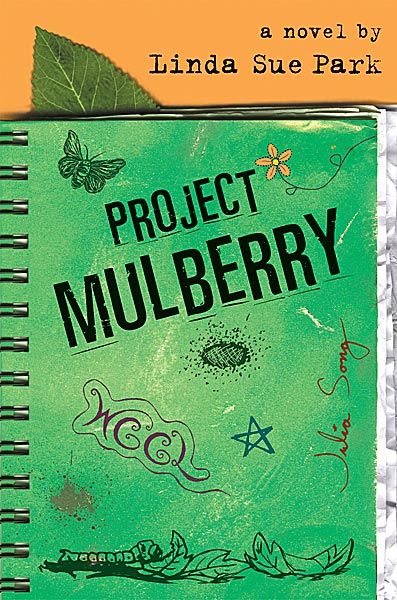
Linda Sue Park’s Project Mulberry brought back memories I had as an elementary school student in which I engaged a “project” much like the main character, Julia Song, the narrator, and her best friend, Patrick. They embark on a science project involving silkworms. Julia is pretty resistant to the project at first, so much so that she even considers sabotaging their progression. Indeed, Julia feels that the project is “too Korean,” especially as it is her mother who gives them the idea about the silkworms. Concurrently, Julia gets interested in embroidery and after warming up to the idea of the silkworm project, she decides that she wants to use the silk from the silkworm cocoons in a sewing type project. What she doesn’t realize is that she will have to kill some of the actual silkworms in order to extract the silk that comprises the cocoons. Will Julia go through with killing some of the silkworms, especially as she has become considerably attached to them or will she decide to forfeit that aspect of the project? The other major tension in the novel involves Julia’s mother and Julia’s belief that she is a racist. Early on in the project, they realize that to raise silkworms they are going to need leaves from a Mulberry Tree, but the only such tree in the local area is owned by Mr. Dixon, a man who happens to be African American. Julia states at one point pretty bluntly that her mother does not like African Americans and she ruminates upon that issue at various points in the novel. The novel’s conclusion includes an author’s note that refers to the interracial tensions between African Americans and Korean Americans in the wake of boycotts and the race riots in New York and Los Angeles respectively. I would not have connected the representations in the fictional world directly to those external referents, so it’s always interesting to hear about authorial intentionality and the rather circuitous ways that creative inspiration gets translated (for lack of a better term) into the fictional world. In any case, this novel is a quick read and is certainly ideal to the younger audiences at which it is primarily directed.
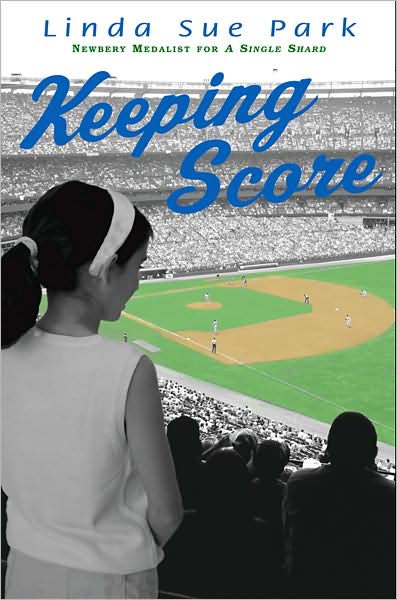
In Keeping Score, Linda Sue Park delves into a different form of historical fiction, which perhaps might be a good pair with When my Name was Keoko as a kind of “flip side” to the Korean transnational experience. In this case, the story revolves around a young girl named Maggie Fortini who becomes a huge Brooklyn Dodgers fan. She devises her own fun way of keeping a score sheet of various statistics for particular baseball games and befriends a fireman named Jim, who is later drafted into the military and sent to Korea. Intending to remain friends, Maggie writes letters to Jim consistently, but he soon stops replying and Maggie is unsure of what has happened and she fears that he may have been injured or even killed. Finally, Maggie’s father reveals that Jim had suffered from some form of PTSD and had been transferred to a mental health institution. Though her father had been forwarding her letters, he had not told her because he was waiting for the right moment to reveal what had gone on. From there, the novel explores how Maggie works to re-articulate the friendship. The novel is interesting insofar as it elliptically narrates the historical contexts of the Korean War through Maggie’s friendship with Jim. But, at the same time, any particular narrative that explores the PTSD of the war veteran also seems to push the civilian deaths at wartime into the background, so I would have to teach a novel like this with Viet Thanh Nguyen’s article, “Speak of the Dead, Speak of Viet Nam.” While the Korean conflict is not necessarily the focal point, it does color how the narrative resolves, as Maggie must think about baseball alongside war, conflict, and violence. The novel is also part of a tradition of young adult fictions complicating normative gender expectations for young women, as they depict young girls and adolescent females as avid sports fans and athletes (see Justina Chen Headley’s Girl Overboard or Wendy Wan Long Shang’s The Great Wall of Lucy Lu).

Linda Sue Park’s A Long Walk to Water was the first book I’ve read by Park, who is also the author of the Newberry award winning A Single Shard. The story is bifurcated. Each chapter starts in the contemporary period with a character named Nya, who lives in Sudan and is part of the Nuel tribe; her family is constantly on the lookout for water. Indeed, it is the kind of dependency that structures their daily lives. After the introductory sequence with Nya, we get the story of Salva, which begins in Southern Sudan in 1985. He is fleeing the area as a conflict between the rebels and the government results in violence and brutality. Salva is separated from his family and travels with a group of refugees where they walk all the way to Ethiopia. Along the way, one of Salva’s friends is killed by a lion and Salva’s uncle is killed by a rival tribe. We discover that the Nuel and the Dinka are tribes that have been in conflict with each other for some time; thus the two narratives are linked in that we know that Nya and Salva come from tribes such that each character would likely think of the other as an enemy. Salva bounces around from refugee camp to refugee camp, moving from Ethiopia to Kenya, escaping listlessness and rebel factions and in one harrowing sequence, must cross a river while avoiding being shot or eaten by crocodiles. He eventually arrives in the United States, only later to discover that his father is actually still alive. The conclusion sees a felicitous family reunion and a possible beginning to a rapprochement between tribes. It is discovered that Salva has become something of a hydro-engineer and is installing wells and pumps for the Nuel tribe. Salva and Nya are thus linked not by their status as enemies, but working toward the common problem of finding more potable sources of water.
A Long Walk to Water is an interesting study in genre because it is a fictionalization of an oral history and thus shows us the porous boundaries between the make-believe and external social contexts. The work includes a note from the individual the narrative is based upon and then an author’s excerpt that provides a larger historical background. After having read through a large handful of these works, it is becoming increasingly apparent that the YA genre is being used as a pedagogical apparatus as a more digestible form through which young adults can interface with historical events and sociocultural circumstances. The author’s note that accompanies the work is important insofar as it continually reminds the readers that a narrative cannot be seen solely as entertainment.
Buy the Book Here:
http://www.amazon.com/When-My-Name-Was-Keoko/dp/0756929288/ref=tmm_hrd_title_0?ie=UTF8&qid=1333386344&sr=8-1
http://www.amazon.com/Project-Mulberry-Linda-Sue-Park/dp/B005IUQZSS/ref=sr_1_11?ie=UTF8&qid=1333640700&sr=8-11
http://www.amazon.com/Long-Walk-Water-Based-Story/dp/0547577311/ref=sr_1_1?ie=UTF8&qid=1332525533&sr=8-1
http://www.amazon.com/Keeping-Score-Linda-Sue-Park/dp/0547248970/ref=sr_1_12?ie=UTF8&qid=1336278825&sr=8-12
A Review of Rana Dasgupta’s Solo (Houghton Mifflin, 2011).

There were two works by English language writers of Asian descent that entirely surprised me in 2011. One was Jessica Hagedorn’s Toxicology. I was not prepared for Hagedorn’s quite inventive and no-nonsense 80 year old narrator. The other was Rana Dasgupta’s Solo. In terms of structure, Dasgupta’s Solo reminds me so much of Ondaatje’s Divisadero because there seem almost to be two novels folded into one. This novel is exactly the kind that makes you want to run out and find someone who has read it so you can discuss what it means. The second half, in particular, which takes on a dream-like quality, makes you wonder about the nature of fiction and reality. In any case, the protagonist, Ulrich, is older than Toxicology’s Eleanor. Indeed, he is 100 years old, blind, and recounting his life. Though Ulrich, Dasgupta is able to explore the quite twisted and difficult history of Bulgaria as a nation intent on an aggressive modernization strategy; he effectively represents the the governmental corruption and policies that end up causing so much damage to its citizens over time. Ulrich gives up his dream to play the violin, ends up becoming a chemist, working in a factory for the government, but his life is full of unanswered questions, regrets, and lost contacts. Thus, the second half of the novel is some sort of fabulist rendering of what life could have been for various “parts” of Ulrich’s dreams had he been able to pursue them. This section is not all rosy by any means, but it does reveal psychological branching points with respect to the ways that Ulrich conceives of his own passions and how those play out in a contemporary Bulgaria. A beautifully written and surprising work and especially interesting given its focus on a country that, to my mind, has not received much attention from English language fiction writers. This kind of novel also makes me quite curious about writerly process, especially since it is quite clear that there must have been extensive ethnographic and historical research that went into the construction of the novel.
Buy the Book Here:
http://www.amazon.com/gp/product/0547397089/ref=pd_lpo_k2_dp_sr_1?pf_rd_p=486539851&pf_rd_s=lpo-top-stripe-1&pf_rd_t=201&pf_rd_i=0007182147&pf_rd_m=ATVPDKIKX0DER&pf_rd_r=1JMQKNRVE718KVZ1GJ59
A Review of Annam Manthiram’s After the Tsunami (Stephen F. Austin University Press, 2011).

After perusing the plot summary for Annam Manthiram’s debut novel, After the Tsunami, I knew it might be relevant to my course on trauma and Asian American literature. This year I’m focusing on narratives in the “first person” and trauma aesthetics more than I have in the past and Manthiram’s work fits the bill to a T. The plot involves a South Asian immigrant man named Siddhartha who has made a successful life in the United States, with a wife and children, but his family knows nothing about his life as a child and they are increasingly interested. Siddhartha’s daughter in particular is increasingly invested in getting to know more about Siddhartha’s past, especially as her impending marriage gets her to think about ancestry and family lines. The novel is split into two time frames, suggesting two simultaneous narrative perspectives by the same person, one from the adult Siddhartha and another from the adult Siddhartha who is looking retrospectively on his childhood living in an orphanage. As we move from one time period to another, we see how much the adult Siddhartha has repressed, and so the novel also slowly unfolds in an Indian orphanage. It’s not clear at first what the problem is: the young boys’ lives are filled with misadventure, but there are issues with food availability and it becomes clear that the orphanage is entirely corrupted, with mothers embezzling government subsidies and others committing sexual abuse upon the children. A shocking and rather gruesome death in the latter half of the novel clarifies the kind of gothic orphanage that Siddhartha has survived and we see that to engage a new life, the trauma victim wills the past to disappear. The novel is useful in terms of thinking about the aestheticization of trauma insofar as we see the split temporalities appear, the evidence of a schizoid subject attempting to compartmentalize abuse and violence in order to move forward. Though this novel is a grueling read, Manthiram shows a nuanced understanding of the ways that trauma manifests and helps contour complicated motivations that attend to migration.
Buy the Book Here:
http://www.amazon.com/After-Tsunami-Annam-Manthiram/dp/1936205432/ref=sr_1_1?ie=UTF8&qid=1334935433&sr=8-1
In this post reviews of: Linda Sue Park’s When my Name was Keoko (Houghton Mifflin Children’s Division, 2004); Linda Sue Park’s Project Mulberry (Houghton Mifflin Children’s Division, 2005); Linda Sue Park’s Keeping Score (Houghton Mifflin Children’s Division, 2008); Linda Sue Park’s A Long walk to Water (Houghton Mifflin Children’s Division, 2010); Rana Dasgupta’s Solo (Houghton Mifflin, 2011); Annam Manthiram’s After the Tsunami (Stephen F. Austin University Press, 2011).
A Review of Linda Sue Park’s When my Name was Keoko (Houghton Mifflin Children’s Division, 2004); Project Mulberry (Houghton Mifflin Children’s Division, 2005); Keeping Score (Houghton Mifflin Children’s Division, 2008); and A Long walk to Water (Houghton Mifflin Children’s Division, 2010).
Pylduck already reviewed Archer’s Quest and I wanted to review as many Linda Sue Park titles as I could, so here are a handful, with the hopes that I will be able to review many more. Pylduck’s review for Archer’s Quest can be found here:
http://asianamlitfans.livejournal.com/109179.html
Linda Sue Park’s When My Name Was Keoko delves into the Japanese colonial period of Korea. Like Yuko Taniguchi’s The Ocean in the Closet and Tabitha Suzuma’s Forbidden, this work is told in alternating first person perspectives, one offered from the viewpoint of Sun-hee (Keoko) and the other from her older brother Tae-yul (Nobuo). As the novel moves forward to the World War II period, tensions heighten on the Korean peninsula; Sun-hee and Tae-yul must only speak in Japanese, take on Japanese names, and offer support for the Japanese military. Some of Sun-hee’s classmates are recruited into the war effort supposedly to work in factories in Japan, but as Park reveals in her author’s note, such a strategem was employed by Japanese military forces to hoodwink young women and they would later become “comfort women,” and forced into sexual servitude. Sun-hee and Tae-yul’s uncle must go into hiding, as it is discovered that he had been using his printing press to publish an underground resistance paper. For his part, Tae-yul enlists in the Japanese army in order to prove his mettle as a Korean citizen. Indeed, he is incensed when Koreans are not considered brave. To disprove this sentiment, Tae-yul signs up for the air force unit training kamikaze pilots, realizing that he will ultimately end up on a suicide mission. Park deftly takes a difficult topic and reorients it toward a young adult audience. Certainly, one of the issues about genre, market and audience is the question of traumatic representation. The novel, while taking on a difficult moment in history, attends to a family and narrators who are particularly vocal and resistant to their colonial subjectivities. At the same time, Park notes that there were colonial sympathizers, ones who might have tactically offered their support of Japanese forces and government in the hopes of securing their individual futures. In these rough waters, the line between heroes and villains becomes much more fraught.
Linda Sue Park’s Project Mulberry brought back memories I had as an elementary school student in which I engaged a “project” much like the main character, Julia Song, the narrator, and her best friend, Patrick. They embark on a science project involving silkworms. Julia is pretty resistant to the project at first, so much so that she even considers sabotaging their progression. Indeed, Julia feels that the project is “too Korean,” especially as it is her mother who gives them the idea about the silkworms. Concurrently, Julia gets interested in embroidery and after warming up to the idea of the silkworm project, she decides that she wants to use the silk from the silkworm cocoons in a sewing type project. What she doesn’t realize is that she will have to kill some of the actual silkworms in order to extract the silk that comprises the cocoons. Will Julia go through with killing some of the silkworms, especially as she has become considerably attached to them or will she decide to forfeit that aspect of the project? The other major tension in the novel involves Julia’s mother and Julia’s belief that she is a racist. Early on in the project, they realize that to raise silkworms they are going to need leaves from a Mulberry Tree, but the only such tree in the local area is owned by Mr. Dixon, a man who happens to be African American. Julia states at one point pretty bluntly that her mother does not like African Americans and she ruminates upon that issue at various points in the novel. The novel’s conclusion includes an author’s note that refers to the interracial tensions between African Americans and Korean Americans in the wake of boycotts and the race riots in New York and Los Angeles respectively. I would not have connected the representations in the fictional world directly to those external referents, so it’s always interesting to hear about authorial intentionality and the rather circuitous ways that creative inspiration gets translated (for lack of a better term) into the fictional world. In any case, this novel is a quick read and is certainly ideal to the younger audiences at which it is primarily directed.
In Keeping Score, Linda Sue Park delves into a different form of historical fiction, which perhaps might be a good pair with When my Name was Keoko as a kind of “flip side” to the Korean transnational experience. In this case, the story revolves around a young girl named Maggie Fortini who becomes a huge Brooklyn Dodgers fan. She devises her own fun way of keeping a score sheet of various statistics for particular baseball games and befriends a fireman named Jim, who is later drafted into the military and sent to Korea. Intending to remain friends, Maggie writes letters to Jim consistently, but he soon stops replying and Maggie is unsure of what has happened and she fears that he may have been injured or even killed. Finally, Maggie’s father reveals that Jim had suffered from some form of PTSD and had been transferred to a mental health institution. Though her father had been forwarding her letters, he had not told her because he was waiting for the right moment to reveal what had gone on. From there, the novel explores how Maggie works to re-articulate the friendship. The novel is interesting insofar as it elliptically narrates the historical contexts of the Korean War through Maggie’s friendship with Jim. But, at the same time, any particular narrative that explores the PTSD of the war veteran also seems to push the civilian deaths at wartime into the background, so I would have to teach a novel like this with Viet Thanh Nguyen’s article, “Speak of the Dead, Speak of Viet Nam.” While the Korean conflict is not necessarily the focal point, it does color how the narrative resolves, as Maggie must think about baseball alongside war, conflict, and violence. The novel is also part of a tradition of young adult fictions complicating normative gender expectations for young women, as they depict young girls and adolescent females as avid sports fans and athletes (see Justina Chen Headley’s Girl Overboard or Wendy Wan Long Shang’s The Great Wall of Lucy Lu).
Linda Sue Park’s A Long Walk to Water was the first book I’ve read by Park, who is also the author of the Newberry award winning A Single Shard. The story is bifurcated. Each chapter starts in the contemporary period with a character named Nya, who lives in Sudan and is part of the Nuel tribe; her family is constantly on the lookout for water. Indeed, it is the kind of dependency that structures their daily lives. After the introductory sequence with Nya, we get the story of Salva, which begins in Southern Sudan in 1985. He is fleeing the area as a conflict between the rebels and the government results in violence and brutality. Salva is separated from his family and travels with a group of refugees where they walk all the way to Ethiopia. Along the way, one of Salva’s friends is killed by a lion and Salva’s uncle is killed by a rival tribe. We discover that the Nuel and the Dinka are tribes that have been in conflict with each other for some time; thus the two narratives are linked in that we know that Nya and Salva come from tribes such that each character would likely think of the other as an enemy. Salva bounces around from refugee camp to refugee camp, moving from Ethiopia to Kenya, escaping listlessness and rebel factions and in one harrowing sequence, must cross a river while avoiding being shot or eaten by crocodiles. He eventually arrives in the United States, only later to discover that his father is actually still alive. The conclusion sees a felicitous family reunion and a possible beginning to a rapprochement between tribes. It is discovered that Salva has become something of a hydro-engineer and is installing wells and pumps for the Nuel tribe. Salva and Nya are thus linked not by their status as enemies, but working toward the common problem of finding more potable sources of water.
A Long Walk to Water is an interesting study in genre because it is a fictionalization of an oral history and thus shows us the porous boundaries between the make-believe and external social contexts. The work includes a note from the individual the narrative is based upon and then an author’s excerpt that provides a larger historical background. After having read through a large handful of these works, it is becoming increasingly apparent that the YA genre is being used as a pedagogical apparatus as a more digestible form through which young adults can interface with historical events and sociocultural circumstances. The author’s note that accompanies the work is important insofar as it continually reminds the readers that a narrative cannot be seen solely as entertainment.
Buy the Book Here:
http://www.amazon.com/When-My-Name-Was-Keoko/dp/0756929288/ref=tmm_hrd_title_0?ie=UTF8&qid=1333386344&sr=8-1
http://www.amazon.com/Project-Mulberry-Linda-Sue-Park/dp/B005IUQZSS/ref=sr_1_11?ie=UTF8&qid=1333640700&sr=8-11
http://www.amazon.com/Long-Walk-Water-Based-Story/dp/0547577311/ref=sr_1_1?ie=UTF8&qid=1332525533&sr=8-1
http://www.amazon.com/Keeping-Score-Linda-Sue-Park/dp/0547248970/ref=sr_1_12?ie=UTF8&qid=1336278825&sr=8-12
A Review of Rana Dasgupta’s Solo (Houghton Mifflin, 2011).
There were two works by English language writers of Asian descent that entirely surprised me in 2011. One was Jessica Hagedorn’s Toxicology. I was not prepared for Hagedorn’s quite inventive and no-nonsense 80 year old narrator. The other was Rana Dasgupta’s Solo. In terms of structure, Dasgupta’s Solo reminds me so much of Ondaatje’s Divisadero because there seem almost to be two novels folded into one. This novel is exactly the kind that makes you want to run out and find someone who has read it so you can discuss what it means. The second half, in particular, which takes on a dream-like quality, makes you wonder about the nature of fiction and reality. In any case, the protagonist, Ulrich, is older than Toxicology’s Eleanor. Indeed, he is 100 years old, blind, and recounting his life. Though Ulrich, Dasgupta is able to explore the quite twisted and difficult history of Bulgaria as a nation intent on an aggressive modernization strategy; he effectively represents the the governmental corruption and policies that end up causing so much damage to its citizens over time. Ulrich gives up his dream to play the violin, ends up becoming a chemist, working in a factory for the government, but his life is full of unanswered questions, regrets, and lost contacts. Thus, the second half of the novel is some sort of fabulist rendering of what life could have been for various “parts” of Ulrich’s dreams had he been able to pursue them. This section is not all rosy by any means, but it does reveal psychological branching points with respect to the ways that Ulrich conceives of his own passions and how those play out in a contemporary Bulgaria. A beautifully written and surprising work and especially interesting given its focus on a country that, to my mind, has not received much attention from English language fiction writers. This kind of novel also makes me quite curious about writerly process, especially since it is quite clear that there must have been extensive ethnographic and historical research that went into the construction of the novel.
Buy the Book Here:
http://www.amazon.com/gp/product/0547397089/ref=pd_lpo_k2_dp_sr_1?pf_rd_p=486539851&pf_rd_s=lpo-top-stripe-1&pf_rd_t=201&pf_rd_i=0007182147&pf_rd_m=ATVPDKIKX0DER&pf_rd_r=1JMQKNRVE718KVZ1GJ59
A Review of Annam Manthiram’s After the Tsunami (Stephen F. Austin University Press, 2011).
After perusing the plot summary for Annam Manthiram’s debut novel, After the Tsunami, I knew it might be relevant to my course on trauma and Asian American literature. This year I’m focusing on narratives in the “first person” and trauma aesthetics more than I have in the past and Manthiram’s work fits the bill to a T. The plot involves a South Asian immigrant man named Siddhartha who has made a successful life in the United States, with a wife and children, but his family knows nothing about his life as a child and they are increasingly interested. Siddhartha’s daughter in particular is increasingly invested in getting to know more about Siddhartha’s past, especially as her impending marriage gets her to think about ancestry and family lines. The novel is split into two time frames, suggesting two simultaneous narrative perspectives by the same person, one from the adult Siddhartha and another from the adult Siddhartha who is looking retrospectively on his childhood living in an orphanage. As we move from one time period to another, we see how much the adult Siddhartha has repressed, and so the novel also slowly unfolds in an Indian orphanage. It’s not clear at first what the problem is: the young boys’ lives are filled with misadventure, but there are issues with food availability and it becomes clear that the orphanage is entirely corrupted, with mothers embezzling government subsidies and others committing sexual abuse upon the children. A shocking and rather gruesome death in the latter half of the novel clarifies the kind of gothic orphanage that Siddhartha has survived and we see that to engage a new life, the trauma victim wills the past to disappear. The novel is useful in terms of thinking about the aestheticization of trauma insofar as we see the split temporalities appear, the evidence of a schizoid subject attempting to compartmentalize abuse and violence in order to move forward. Though this novel is a grueling read, Manthiram shows a nuanced understanding of the ways that trauma manifests and helps contour complicated motivations that attend to migration.
Buy the Book Here:
http://www.amazon.com/After-Tsunami-Annam-Manthiram/dp/1936205432/ref=sr_1_1?ie=UTF8&qid=1334935433&sr=8-1


![[personal profile]](https://www.dreamwidth.org/img/silk/identity/user.png)
no subject
Date: 2012-05-06 04:32 pm (UTC)I want to read SOlo!! :D
no subject
Date: 2012-05-08 04:01 pm (UTC)no subject
Date: 2012-05-07 12:05 am (UTC)no subject
Date: 2012-05-08 03:57 pm (UTC)no subject
Date: 2012-05-08 04:01 pm (UTC)no subject
Date: 2012-05-08 04:01 pm (UTC)no subject
Date: 2012-05-08 03:58 pm (UTC)no subject
Date: 2012-05-08 04:02 pm (UTC)